When Nobody's Watching: The Invisible Artist Who Painted His Way Into America's Greatest Museum
The Route That Changed Everything
Every Tuesday morning at 5:30 AM, Marcus Williams would start his garbage route through the affluent Riverside district of Cincinnati. While most people saw only trash cans and recycling bins, Marcus saw something else entirely: a treasure trove of abandoned art supplies.
Paint tubes squeezed nearly empty but still holding precious color. Brushes with bent bristles that wealthy art students had discarded. Canvases with failed attempts that Marcus knew could be scraped clean and reborn. For three decades, he quietly collected these castoffs, storing them in the back of his sanitation truck like a secret museum curator.
"I figured if they were throwing it away, they wouldn't miss it," Marcus would later tell reporters. What he didn't mention was the deeper truth: these discarded materials represented dreams that others had given up on, and Marcus Williams had never stopped dreaming.
The Studio Nobody Knew About
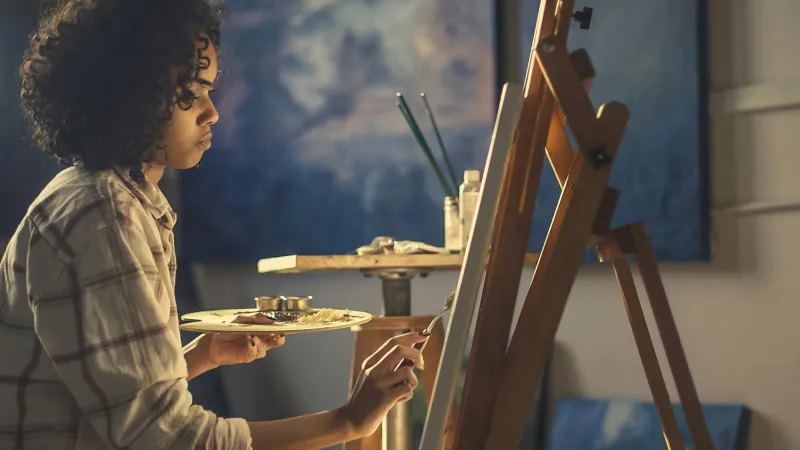
Marcus's apartment was a study in creative constraint. In the cramped 400-square-foot space he shared with his wife Dorothy, he carved out a corner that measured barely six feet by eight feet. This became his studio, workshop, and sanctuary all at once.
Working by the light of a single desk lamp after his shifts ended, Marcus taught himself to paint using library books and pure instinct. He mixed colors on dinner plates, used coffee cans as water containers, and stretched salvaged canvas over wooden frames he built himself. Every surface in that tiny corner told a story of resourcefulness born from necessity.
"He'd come home exhausted, but he'd still spend hours in that corner," Dorothy remembered. "I used to worry he was pushing himself too hard, but I could see it fed his soul in ways nothing else could."
What emerged from that cramped space defied every convention of the art world. Marcus painted what he saw and felt: the dignity in discarded objects, the beauty in forgotten corners of the city, the humanity in faces that society often overlooked. His technique was entirely his own, developed without the burden of academic rules or market expectations.
The Accidental Discovery
For twenty-eight years, Marcus painted in complete solitude. He never showed his work, never sought validation, never even considered himself a "real" artist. The paintings accumulated in his apartment like a secret archive of urban poetry.
Then came the fire.
A kitchen accident in 2019 forced Marcus and Dorothy to evacuate their building temporarily. As firefighters cleared the apartments, one of them noticed the extraordinary paintings lining every wall of the Williams' home. Word spread quickly through the department, then to a local newspaper photographer, and finally to Sarah Chen, a curator from the Contemporary Arts Center.
"I've been in this field for fifteen years," Chen said, "and I've never seen anything like Marcus's work. It had this raw authenticity that you simply cannot manufacture or teach."
Chen wasn't alone in her assessment. Within months, Marcus's story had reached the Smithsonian American Art Museum in Washington, D.C.
The Power of Invisible Advantage
What made Marcus Williams's art so compelling wasn't just his technical skill—it was his complete freedom from the art world's expectations and limitations. While MFA students learned to paint what would sell and established artists chased trends, Marcus painted truth as he experienced it.
"Marcus never had to unlearn anything," explained Dr. Jennifer Martinez, the Smithsonian curator who first championed his work. "He never absorbed the subtle prejudices about what subjects were worthy of fine art, or which techniques were acceptable. His outsider status became his greatest strength."
His paintings captured moments that credentialed artists might overlook: the way morning light hit a pile of discarded furniture, the expression on a fellow worker's face during a lunch break, the unexpected beauty in the industrial landscape of his daily route.
This invisibility—both as a person moving through affluent neighborhoods and as an artist working without recognition—allowed Marcus to develop a voice that was entirely his own.
Recognition at Last
In 2021, the Smithsonian American Art Museum acquired twelve of Marcus Williams's paintings for their permanent collection. The acquisition made headlines not just for the unusual circumstances of the discovery, but for the undeniable power of the work itself.
"Marcus Williams represents something essential about American creativity," said museum director Kevin Gover at the acquisition announcement. "His story reminds us that artistic genius can emerge anywhere, often in the places we least expect to find it."
The first painting to be displayed was "Tuesday Morning, Riverside"—a luminous portrait of his garbage truck parked beneath flowering cherry trees, painted entirely with supplies he'd rescued from the very neighborhood the painting depicted.
The Lesson in the Corner
Today, Marcus Williams continues to paint in that same eight-by-six-foot corner of his apartment, though he no longer needs to scavenge for supplies. The Smithsonian acquisition provided enough financial security for him to buy proper materials, but he still prefers working in his familiar space.
"This corner taught me everything I needed to know," he says. "You don't need a fancy studio or expensive equipment to make something beautiful. You just need to pay attention to what's already there."
His story challenges every assumption about who gets to be an artist and what constitutes legitimate creative expression. In a world obsessed with credentials and connections, Marcus Williams proved that sometimes the most powerful advantage is simply being overlooked long enough to find your own voice.
The garbage collector who painted his way into the Smithsonian didn't just create art—he redefined what it means to be an artist in America. And he did it all from a corner that nobody else would have thought to look.