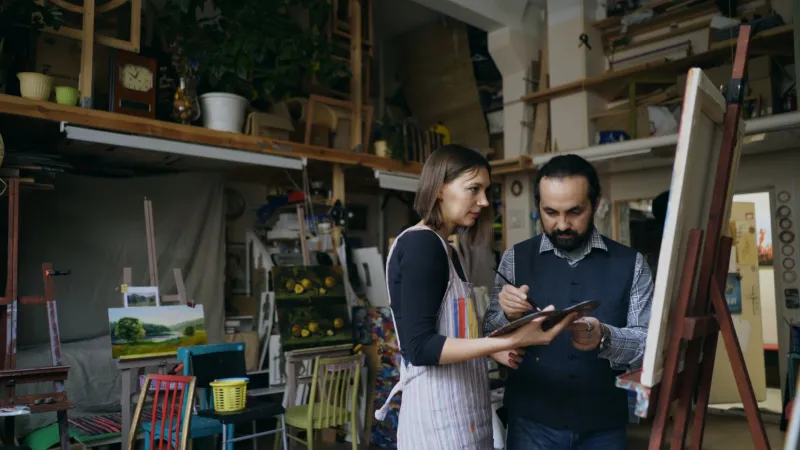
When the Lights Went Out, She Learned to Read Buildings With Her Hands

Photo by Photo by taopaodao on Unsplash on Unsplash
The Blueprint She Never Finished
Caroline Marsh had been drawing buildings since she was nine years old. Not doodling — drawing. Floor plans scratched out on graph paper, elevation sketches taped to her bedroom wall in Knoxville, Tennessee, buildings that existed nowhere except in the precise and confident lines of a kid who already knew, somehow, exactly what she was meant to do.
By the time she graduated from the University of Tennessee's College of Architecture in 1974, she had a job offer in Chicago, a mentor who called her the most spatially intuitive student he'd taught in thirty years, and the kind of momentum that makes a life look inevitable from the outside.
Seven months later, she woke up in a hospital bed and couldn't see the window.
The diagnosis was a rare autoimmune condition that had attacked her optic nerves with catastrophic speed. The vision loss was total and permanent. She was twenty-two years old, and every plan she had made — every drawing, every model, every carefully imagined future — was built around something she no longer had.
The Year She Didn't Draw
Marsh spent the better part of a year doing very little. That's how she described it later, in the blunt and unsparing way she had of talking about hard things: "I spent a year doing very little."
She learned Braille. She learned to navigate her apartment in Knoxville without touching the walls. She learned that grief, when it's thorough enough, has its own kind of architecture — rooms you move through in a specific order, doors that open only after you've stood in front of them long enough.
What she didn't do was go back to architecture. The profession, as she understood it, was a visual discipline. Blueprints. Renderings. The ability to look at a space and see, in your mind, how light would fall through a window at four in the afternoon in January. She had lost the instrument the work required, and she was not yet ready to imagine a different instrument.
That changed in 1976, when a friend took her to a newly renovated federal building in downtown Knoxville — one of the first public buildings in Tennessee to attempt compliance with the newly passed Rehabilitation Act of 1973. The ramps were there. The signage had Braille overlays. On paper, the building was accessible.
Marsh walked through it and knew, within ten minutes, that it was a disaster.
The Education a Drafting Table Can't Give You
The ramps were technically correct but practically brutal — steep enough that a wheelchair user would need help on the incline. The Braille signage was mounted at eye level for a standing adult, which meant it was useless for anyone in a chair and awkward for anyone using a cane. The bathroom doors opened inward, which meant a person who used a walker had to step back to pull the door while simultaneously holding it open. The acoustic properties of the lobby — all hard surfaces, high ceilings, and parallel walls — created an echo so disorienting that Marsh, navigating by sound as she had learned to do, couldn't tell where the elevator was until she nearly walked past it.
The building had been designed by sighted architects consulting a checklist. Nobody had moved through it blind. Nobody had rolled through it in a chair. The compliance was real. The experience was punishing.
Marsh went home and picked up a pen — not to draw, but to write. She drafted a twelve-page critique of the building's experiential failures, specific and technical and furious in the way that only someone who has been failed by a system can be furious. She sent it to the building's architectural firm.
They called her the following week and offered her a consulting contract.
A New Language for Space
What Marsh developed over the next two decades wasn't a theory. It was a practice — a methodology for understanding buildings not as visual objects but as lived experiences. She called it, in her 1989 handbook that became required reading in architecture programs across the country, "the ethics of arrival" — the idea that a building makes a moral argument every time someone approaches its door, and that argument is legible in the choices the architect made.
She worked with her hands. She built scale models and ran her fingers over them, noting where a turn required more than ninety degrees of rotation, where a threshold created a tactile barrier, where a corridor narrowed in ways that felt threatening before they became physically impassable. She brought blind consultants, wheelchair users, elderly testers, and people with cognitive disabilities into buildings before they opened and after they opened and, when she could get in front of the right clients, before they were built.
The work was slow. The industry resisted. There were architects — accomplished, award-winning architects — who told her, more than once, that she was designing for the exception rather than the rule. She had a response she used so often it became a kind of personal motto: "There is no rule. There are only people."
By the mid-1980s, her firm, Marsh Accessibility Partners, had consulted on more than two hundred projects across twenty states. Her influence on the Americans with Disabilities Act's architectural standards, passed in 1990, is documented in the congressional record — she testified twice, and her handbook was cited in the regulatory commentary.
The Asset She Didn't Choose
People asked her, throughout her career, whether she would take her sight back if she could. It's the kind of question that gets asked of people who have built something remarkable from loss — a question that wants the answer to be no, because that answer makes a better story.
Marsh didn't give the better story. She said yes, probably. She missed color. She missed the particular pleasure of looking at a finished building from across the street and seeing it whole.
But she also said this: the architecture she produced after losing her sight was better than anything she could have made before. Not because blindness was a gift — she was careful about that framing, almost allergic to it — but because it forced her to understand something that sighted architects rarely have to confront: that a building is not a picture. It is a sequence of physical experiences, and those experiences belong to everyone who enters, not just the people the architect imagined when the design was drawn.
She couldn't see her buildings. So she learned to feel them. And in doing so, she made them feel better to everyone else.
The lights went out. She found a different way to read the room. And the rooms, in turn, got better at welcoming the people who needed them most.