Between the Stacks and the Cell Blocks: The Librarian Who Heard a Poet the World Had Muted
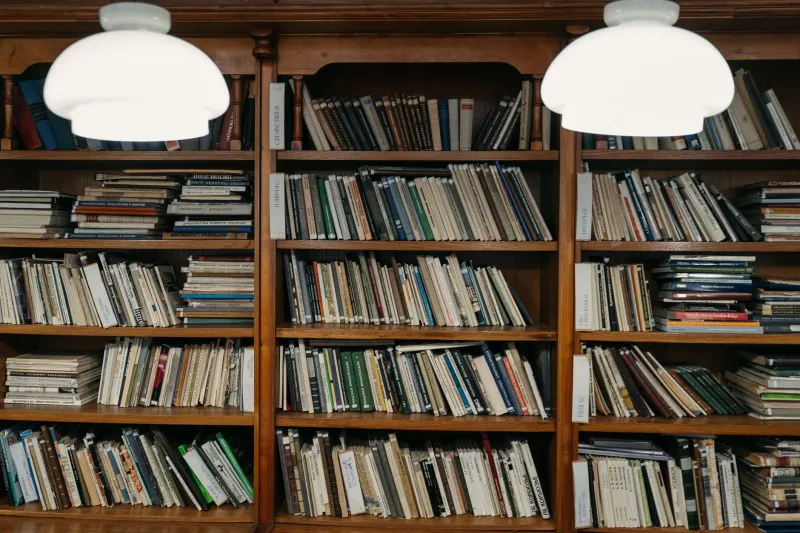
The library at Whitfield Correctional Center in rural Georgia is not a large room. Three long shelves, a rack of donated paperbacks sorted loosely by genre, a table with four plastic chairs, and a window that looks out onto a concrete exercise yard. Ruth Calloway had worked in that room for eleven years before she understood that it was, in some important sense, the most consequential library she'd ever been in.
She'd worked in public libraries before Whitfield. A branch in Macon, a bookmobile circuit in two rural counties, a brief stint at a university archive. She'd taken the correctional facility position because the hours were steady and the commute was manageable, and she'd stayed because — in a way she had trouble articulating at first — the patrons needed the books more than anyone she'd served before.
"In a public library, you can leave," she said in one of the few interviews she's given. "Here, the books come to you. That changes the relationship."
The Folded Paper
Darnell Osei had been incarcerated at Whitfield for six years when he first spoke to Ruth beyond the transactional exchange of checking books in and out. He was thirty-four, serving a twelve-year sentence, and he had the focused quietness of someone who had learned to take up as little space as possible.
He read constantly. Mostly history, some philosophy, and — in a pattern Ruth noticed and filed away — a great deal of poetry. Langston Hughes, Gwendolyn Brooks, Yusef Komunyakaa, Terrance Hayes. He'd work through a collection slowly, sometimes returning a book three or four times before he was finished with it.
The folded piece of paper came on an unremarkable Tuesday afternoon. He pushed it across the table without meeting her eyes and said she could throw it away if she wanted. It was just something he'd written. He didn't know why he was showing her.
Ruth unfolded it that evening at home. She read it twice. Then she read it a third time, more slowly.
It was, she would later say to a journalist from the Atlanta Journal-Constitution, one of the most formally accomplished poems she'd read in years — and she was not a person who said things like that casually. She had a literature degree from Georgia State and had spent significant portions of her adult life in the company of books. She knew the difference between competent writing and something that did something to the air in the room.
The Work of Believing
What Ruth did next was not complicated. It was just rare.
She asked Darnell if he had more. He did — notebooks, dozens of pages, written over years with no particular audience in mind. She asked if she could read them. He said yes, with the careful hesitation of someone who had learned not to want things too openly.
Over the following months, Ruth read everything he'd written. She offered feedback when he asked for it and held back when he didn't. She brought him books she thought would matter to him — not to instruct, but to give him company for what he was already doing. She treated his work with the same seriousness she would have applied to any writer she respected, which was, it turned out, exactly what it needed.
She also started making calls.
Ruth had maintained a loose network of contacts from her years in library work — a professor here, a small press editor there, a former colleague who'd moved into literary magazine publishing. She wasn't a literary agent and had no pretensions to being one. But she knew enough people who knew enough people, and she believed, with a certainty that occasionally surprised her, that Darnell Osei's work deserved to be read by more than the four plastic chairs in the Whitfield library.
What the World Had Missed
The bureaucratic complications of working with an incarcerated writer were considerable. Submissions required institutional approval. Correspondence was monitored. The timeline for everything was longer and more uncertain than in the ordinary literary world, which is already not known for its speed.
Ruth navigated all of it with the methodical patience of someone who had spent her career managing systems designed for other people's convenience. She submitted Darnell's work to journals under his name, with his full knowledge and participation. She handled the correspondence. She kept him informed of every development, every rejection, every tentative expression of interest.
The rejections came first, as they almost always do. Then, about eighteen months into the process, a small but well-regarded literary journal in Chicago accepted a sequence of five poems. Then another journal. Then a request from a university press editor who had read the journal work and wanted to know if there was more.
There was more. There was considerably more.
A Voice That Had Always Been There
Darnell Osei's debut collection was published by a university press while he was still incarcerated. The book received attention that surprised the press and surprised Ruth and, by his own account, surprised Darnell himself — not because he doubted the work, but because he had spent years operating on the assumption that the work existed only for him.
Reviews described the collection as "formally rigorous and emotionally devastating," "a major debut from a voice that should have reached us sooner," and — in a phrase that circulated widely — "proof that American poetry has been conducting its conversations in rooms that were too small."
Darnell was released two years after the book's publication. He has since published a second collection, taught poetry workshops at two universities, and been the subject of a documentary that premiered at a regional film festival in 2022.
Ruth Calloway still works at Whitfield. She has not made a habit of publicizing her role in Darnell's story, partly from professional discretion and partly because she doesn't think of it as her story to tell.
"I just read what he gave me," she has said. "And I believed it. That shouldn't be remarkable. That should be the minimum."
The Room That Was Always There
What Ruth understood, in that small library with its plastic chairs and its window onto the exercise yard, is something that gets lost in conversations about talent and opportunity: the work of believing in someone is not passive. It requires showing up, consistently, in a room where showing up is inconvenient, and treating what you find there with the seriousness it deserves.
Genius doesn't wait for convenient locations. It shows up where it shows up, in folded pieces of paper passed across tables by people who have learned to expect nothing.
The only question is whether anyone is paying attention.