The Man Who Could Barely Write His Name Built a Library That Still Stands
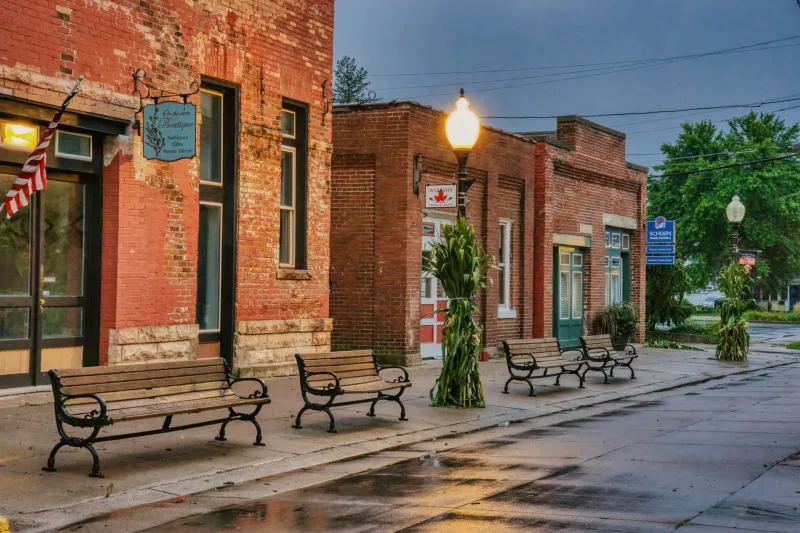
There's a certain irony to the fact that the man who gave Granite Falls, Minnesota its first public library couldn't reliably spell the name of the town he'd lived in for eleven years.
 Photo: Granite Falls, Minnesota, via admin.viatravelers.com
Anton Vukovic had arrived from the Dalmatian coast of Croatia in 1919, twenty-two years old and carrying almost nothing. He spoke no English. He could read Croatian haltingly, write it even less reliably, and had received the kind of education that rural poverty in early twentieth-century Europe tended to produce: enough to get by, not enough to get far. He found work in the steel industry, eventually landing in Granite Falls, a small Minnesota town on the Yellow Medicine River that was, by 1920, home to a modest but growing community of Central and Eastern European immigrants.
 Photo: Anton Vukovic, via slovenska-atletika.si
He learned English the way most immigrants of his era did — piecemeal, imperfectly, through necessity. He could hold a conversation. He could follow instructions. He could read a newspaper headline if the words weren't too long. Writing remained, throughout his life, a laborious process that he avoided when he could and apologized for when he couldn't.
And yet.
The Thing About Not Being Able to Read
People who have always read easily tend to underestimate what reading means to people who can't. For Anton Vukovic, literacy wasn't a convenience or an intellectual pleasure. It was a locked door he spent his entire adult life pressing against.
He watched his children learn English in school and felt something he couldn't quite name — not jealousy, exactly, but a fierce, aching awareness of what he might have become with access to what they were being given. He began, in his forties, making a habit of having his eldest daughter read to him in the evenings. History. Geography. Whatever the school library sent home. He listened with an attention that his daughter later described as almost alarming — the concentration of a man who knows he is getting something he wasn't supposed to have.
In 1929, the stock market collapsed and the Depression settled over Granite Falls like a long winter that didn't intend to end. The town's small economy contracted. The school library, already underfunded, began cutting back. And Anton Vukovic, watching the books disappear from his children's hands, made a decision that everyone around him thought was somewhere between admirable and insane.
He was going to get his town a library.
The Campaign Nobody Asked For
He started with city council. This was, by most accounts, not a comfortable experience for anyone involved. Anton's English was functional but not elegant, and formal civic proceedings were not his natural habitat. He showed up anyway, three meetings in a row, with a handwritten petition — the handwriting, witnesses later noted, was difficult to decipher — signed by sixty-seven residents who wanted a public lending library.
The council was not opposed to the idea in principle. They were opposed to it in practice, specifically the practice of spending money during a depression on books when people needed food. Anton's counterargument was characteristically blunt: people needed both, and the food problem was being addressed by other people, so he would address the book problem himself.
They didn't say yes. They didn't say no. They said they'd consider it.
Anton didn't wait.
He began collecting books the way he'd collected everything in his life — through sheer, grinding persistence. He wrote letters (dictated to his daughter, who corrected the spelling) to churches, schools, and civic organizations across Minnesota asking for donated volumes. He drove his wagon to farmsteads and small businesses in Yellow Medicine County, explaining in his approximate English what he was trying to build and why. He was, by all accounts, utterly impossible to say no to — not because he was charming, exactly, but because his conviction was so unambiguous that refusing him felt like refusing something more fundamental than a book request.
By the spring of 1931, he had collected over eight hundred volumes.
The Mortgage
The books needed a home. Anton had identified a vacant storefront on the main street that could be rented cheaply, but cheaply still meant money, and money in 1931 in Granite Falls was not something people had lying around. He went to the bank and mortgaged his house.
His wife, Marta, has been quoted in local historical records as saying that she did not argue with him. She had learned, over the years, that when Anton decided something was necessary, arguing was a way of spending energy that could be better directed toward helping it happen. She helped him carry boxes.
The Granite Falls Public Reading Room opened in June of 1931. Anton had hand-lettered the sign himself — the spelling, a neighbor gently noted, required one small correction before it went up. He accepted the correction without embarrassment and fixed it.
On opening day, forty-three people came through the door.
What He Built and What It Meant
Anton Vukovic never became a great reader. His literacy improved incrementally over the years, but it remained effortful, and he remained a man who understood books primarily through what other people told him they contained. He ran the library's early operations with the help of volunteers and, eventually, a part-time librarian funded through a small county grant he lobbied for with the same dogged persistence he'd applied to everything else.
He remained on the library's volunteer board until he died in 1958. He attended every meeting. He never stopped advocating for more books, more hours, more access — particularly for the immigrant families and farm children he saw as the library's most important constituency, the ones for whom reading was not a luxury but a ladder.
The library he founded still operates in Granite Falls today, now part of the Pioneerland Library System. A small plaque near the entrance notes its founding in 1931. Anton's name is on it.
Andrew Carnegie funded hundreds of libraries across America with his steel fortune, and history has rightly remembered him for it. But Carnegie had every advantage that literacy, wealth, and institutional access could provide. He gave from abundance.
Anton Vukovic gave from hunger — the specific, irreplaceable hunger of a man who understood exactly what he was missing and decided, with his approximate spelling and his mortgaged house and his wagon full of donated books, that his town wasn't going to miss it too.
That's a different kind of generosity. It might be the rarer kind.