Nights on the Door, Days in the Stacks: The Bouncer Who Taught Himself to Read the Brain
Marcus Teel will tell you, if you ask him, that the library saved his life twice. The first time was when he was twelve, hiding from a home situation that made the children's section feel like the safest room in Chicago. The second time was when he was twenty-four, standing outside a nightclub on the North Side at two in the morning, trying to understand why the things he'd seen and absorbed in his childhood still showed up uninvited, like a guest nobody had buzzed in.
The second time, though, the library didn't just save him. It turned him into something nobody expected.
The Job That Paid and the Question That Didn't
Bouncing is not a career most people plan for. Marcus fell into it the way a lot of young men from his neighborhood fell into the work available to them — through a connection, through a physical presence that made him useful, through the absence of other options that paid as well for someone without a college degree.
He was good at it. Calm under pressure, observant, slow to escalate. The club owner valued him precisely because he didn't enjoy conflict the way some of the other guys did. He could read a situation before it became a situation, which is the most important skill in the job and the one that can't be taught.
But the nights were long, and the things Marcus saw at the door — and the things he carried from long before the door — were accumulating in a way that demanded some kind of accounting. He wasn't sleeping well. He was having reactions to things that didn't warrant them. He recognized, without having the vocabulary for it yet, that his nervous system was doing something he didn't understand and couldn't control.
So he went to the library. Not to find a self-help book. To find out what was actually happening inside his head.
The Education in the Stacks
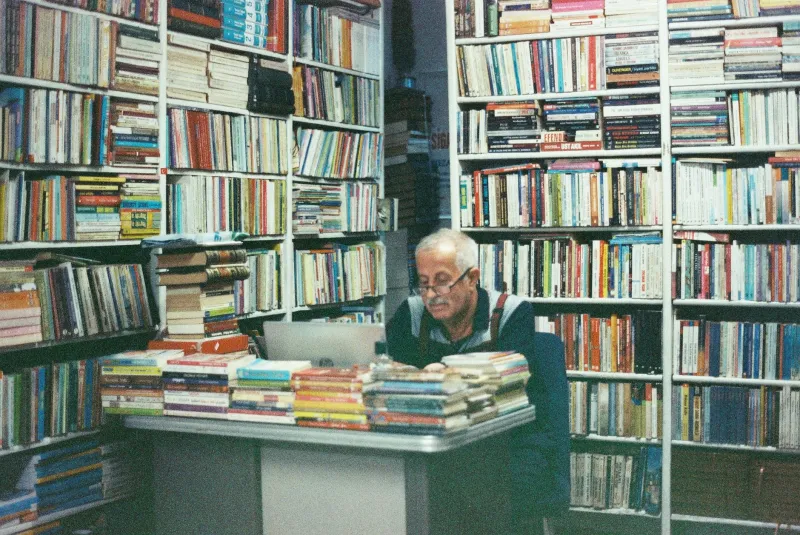
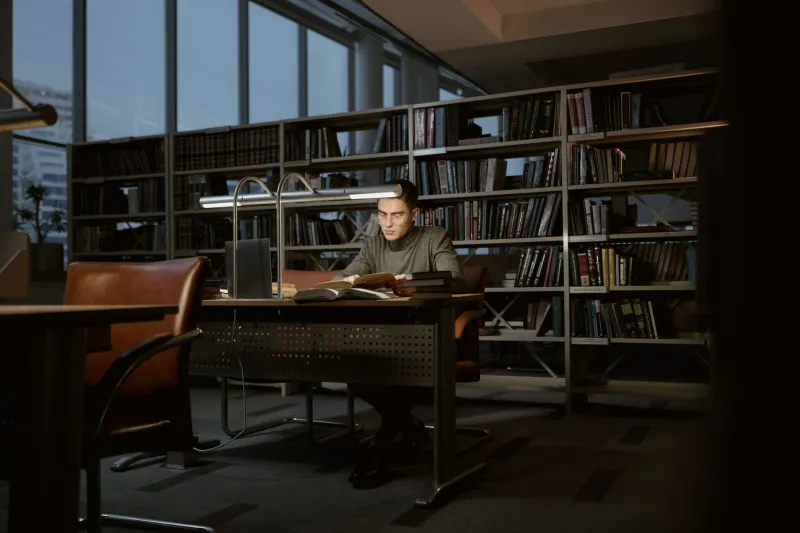
The Harold Washington Library Center in Chicago is a remarkable institution — a research-grade collection accessible to anyone who walks through the door. Marcus walked through it at eight in the morning, after his shifts ended, and stayed until early afternoon before going home to sleep.
He started with whatever he could find that was readable. Popular neuroscience, psychology textbooks with library stickers on the spine, anything that used plain language to explain how the brain worked. He took notes in composition notebooks, the cheap kind, filling them with vocabulary he was learning and questions he didn't yet have the framework to answer.
The vocabulary was the first barrier. The second was the paywall around academic research. Marcus got around both the same way — slowly, methodically, and without any sense that he was doing something unusual. He found a reference librarian named Dorothea who took his questions seriously and helped him locate journal articles through interlibrary loan. He learned to read abstracts before deciding whether a full paper was worth the effort. He built a mental map of the field the way a traveler builds a map of an unfamiliar city — one landmark at a time, backtracking when necessary, gradually accumulating a sense of the whole.
What he was teaching himself, without calling it that, was neuroscience. Specifically, the neuroscience of trauma: how chronic stress reshapes the developing brain, how the amygdala and prefrontal cortex interact under threat conditions, how early adverse experiences alter the architecture of stress-response systems in ways that persist into adulthood.
He was reading about himself. But he was also, without fully realizing it, developing genuine expertise.
The Mentor Who Showed Up
The pivot point came through the library, appropriately enough. A professor from a local university — Dr. Anita Caldwell, a cognitive neuroscientist who ran a community education series on mental health — came in to give a public talk on stress and memory. Marcus attended. At the end, he asked a question.
Dr. Caldwell later said that the question stopped her. Not because it was wrong, but because it was right in a way that suggested the person asking it had done serious reading. She asked Marcus where he'd studied. He told her he hadn't. She asked him what he'd read. He named papers. She invited him to come talk to her at the university.
What followed was an informal mentorship that lasted three years. Dr. Caldwell gave Marcus access to her lab's resources and her graduate students' study groups. She assigned him reading and met with him monthly to discuss it. She was clear-eyed about what she was doing: not sponsoring a degree program or making promises about his future, but offering a serious person access to a serious intellectual community because he had earned it through his own effort.
Marcus continued bouncing through most of this period. The night job funded the day project. He slept in the middle.
The Contribution
In the early 2010s, Dr. Caldwell's lab was working on a study examining the relationship between early trauma exposure and adult patterns of threat assessment — specifically, the question of whether certain hypervigilant behavioral adaptations that develop in high-stress environments represent cognitive deficits or, in some contexts, functional advantages.
Marcus contributed something the credentialed researchers hadn't thought to look for: a framework for understanding how threat-assessment skills developed in survival contexts might map onto neurological processes in ways the existing literature hadn't adequately described. He wasn't running experiments. He was offering a perspective, grounded in years of reading and a lifetime of lived experience, that reframed some of the assumptions the team had been working from.
His contribution was acknowledged in the published paper — not as a co-author, but in the acknowledgments section, with a description of his role. For Marcus, that was not the point. The point was that the idea had been useful. That what he'd built in the library stacks, over years of early mornings and composition notebooks, had been real enough to matter.
What the Door Taught the Lab
Marcus eventually completed a bachelor's degree in his late thirties — psychology, at a state school, while still working security part-time. He went on to complete a graduate program in clinical mental health counseling, and today he works with a nonprofit in Chicago that serves young men from high-trauma backgrounds.
He talks to them about the library sometimes. About the idea that education is not a building you get accepted into but a practice you take up, one book at a time, one question at a time, in whatever room will have you.
He still carries the composition notebooks. Not all of them — there are too many now. But a few of the early ones, from the years when he was figuring out what his own brain had been doing all his life.
"I wasn't trying to become a scientist," he said recently. "I was trying to understand something. The science was just the best tool I found for doing that."
The library opened at eight. He was always there when it did.