She Stitched Her Family Together on Nothing. Then the Fashion Industry Borrowed Her Needle.
There is a particular kind of intelligence that only emerges under pressure. Not the intelligence of classrooms or credentials, but the kind that develops when failure is not an option — when the thing you're making has to hold because you cannot afford for it not to.
Vera Mae Hutchins understood this without ever having a name for it. She was twenty-six years old, living outside of Valdosta, Georgia, with seven children, a sewing machine that was older than her marriage, and a business that amounted to a handwritten sign in the window of her house that read: Alterations and Sewing. Reasonable Rates.
She was not trying to revolutionize the garment industry. She was trying to get through the week.
What she invented in the process took the industry forty years to fully catch up with.
The Workshop That Wasn't
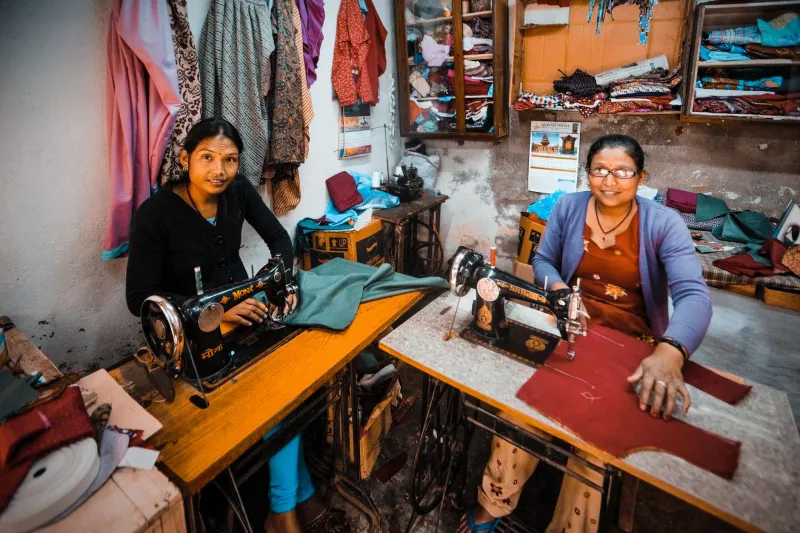
The sewing room in Vera Mae's house was the kitchen table, cleared after dinner. Her tools were what she could afford: a secondhand Pfaff machine, a collection of hand-me-down notions, and thread she bought in bulk because buying in bulk was the only economy available to her.
She took in everything. Bridesmaid dresses, work uniforms, children's Easter clothes, alterations on suits for men who needed to look presentable for job interviews. She charged modestly because her clients were people like her — people for whom modest was still a stretch.
The work had to be good. Not good in the sense of aesthetically impressive, though Vera Mae had a genuine eye for proportion and fit. Good in the sense of lasting. Her clients couldn't afford to come back in six months because a seam had given out. She couldn't afford the reputation hit if they did.
This pressure — invisible, unacknowledged, but constant — drove her to solve a problem that professional manufacturers had largely learned to live with.
The Problem With How Things Were Done
In conventional garment construction, seam stress is managed through a combination of seam allowance width, stitch density, and fabric selection. It works well enough under normal conditions. But stress in clothing isn't evenly distributed, and the points where garments fail — underarms, seat seams, shoulder junctions — are almost always the same points. The industry knew this. It had known it for generations. The accepted solution was to reinforce those points after the fact: bar tacks, stay stitching, interfacing.
Vera Mae came at the problem from a different direction, because she didn't have the reinforcement materials that commercial operations used, and because she was constructing garments that needed to survive hard daily wear — children playing, adults working physical jobs, fabric being laundered repeatedly in hot water because her clients didn't have gentle-cycle habits.
She began experimenting with the geometry of the seam itself. Instead of treating high-stress junctions as problems to be patched after construction, she started building the stress distribution into the cut. She modified her pattern pieces so that the seam lines at critical junctions were curved in a specific way — not dramatically, but precisely — that redistributed tension across a wider surface area rather than concentrating it at a single point.
She also developed a two-pass stitching method for those junctions that looked, from the outside, almost identical to a standard seam, but created an internal structure that dramatically increased the amount of force the seam could absorb before showing any sign of stress.
She didn't call it anything. It was just how she sewed.
The Daughter Who Wrote It Down
Vera Mae's fifth child, a daughter named Patricia, grew up watching her mother work. Patricia was the one who eventually recognized that what her mother was doing was not standard practice.
In the late 1970s, Patricia enrolled in a vocational textile program in Atlanta. In her second semester, during a unit on garment construction, she demonstrated her mother's technique to an instructor who stopped the class and asked her to do it again.
"Where did you learn that?" the instructor asked.
"My mama," Patricia said.
The instructor — a woman who had spent twenty years in commercial pattern making — had never seen the approach. She asked Patricia to bring her mother in.
Vera Mae came. She sat in the classroom and answered questions for two hours, demonstrating her methods on a borrowed machine with the same quiet efficiency she brought to everything. She was in her fifties by then, still running her kitchen-table operation, still sewing for the same community she'd always served.
The instructor submitted a paper documenting the technique to a regional textile industry publication. It was the first time Vera Mae's method had ever been formally described.
From Valdosta to the Cutting Room Floor
The paper didn't cause an overnight sensation. These things rarely do. But it circulated through the right hands. A production manager at a mid-sized apparel manufacturer in North Carolina read it and recognized immediately that the geometry Vera Mae had developed addressed a defect-rate problem his quality control team had been fighting for years.
He reached out to Patricia, who connected him with Vera Mae. There were phone calls, then a visit. Vera Mae walked through his production floor, looked at his standard construction process, and pointed out, with characteristic directness, exactly where his seams were failing and why.
The manufacturer retrained his construction staff using her method. His defect rate on high-stress seam points dropped significantly within a production cycle. He told other people. Other people tried it. The technique spread the way genuinely useful ideas spread — not through marketing or fanfare, but because it worked, and the people who used it told the people who hadn't.
By the 1990s, variants of Vera Mae's curved-junction construction and her two-pass stress-seam method had been absorbed into the standard practices of manufacturers who had no idea where the approach had originated. It had become, in the language of the industry, simply the right way to do it.
What She Never Got, and What She Did
Vera Mae Hutchins never received a patent. She never received royalties. She was not celebrated by the industry that quietly adopted her innovations, because the industry didn't know it was adopting them — or, if it did, the knowledge of their origin had been laundered out through enough intermediate steps to become untraceable.
What she did receive was a different kind of recognition. Late in her life, Patricia worked with a textile history researcher to document her mother's contributions properly. Vera Mae gave interviews. She demonstrated her techniques on camera. She answered every question with the same matter-of-fact tone she brought to everything, as if the whole conversation were slightly beside the point.
"I just needed the seams to hold," she said in one of those interviews, needle moving through fabric with the ease of long habit. "That's all I was ever trying to do."
Seven kids raised. Lights kept on. Seams that held.
Some legacies don't need a showroom.