The Language of Touch: How a Deaf Artist Taught America to See Differently
Born Into Silence
Evelyn Marsh came into the world in 1934 in a small house outside Asheville, North Carolina, the second daughter of a tobacco farmer and a seamstress. She was born hearing. By eighteen months, a severe fever had taken that from her. Her parents, neither of whom had any experience with deafness, did what most rural families of that era did: they adapted slowly, imperfectly, and with a lot of love that didn't always know how to express itself.
Evelyn grew up in a world that communicated around her more than with her. She developed a sensitivity to vibration, texture, and spatial presence that her family gradually came to recognize as something beyond compensation — it was perception operating on a different frequency entirely. She felt the thud of her father's boots on the porch before he reached the door. She knew when a storm was coming by the way the air pressed against her skin. She experienced the world, as she would later write in a rare personal essay, "through the parts of myself that most people forget they have."
The Mud Years
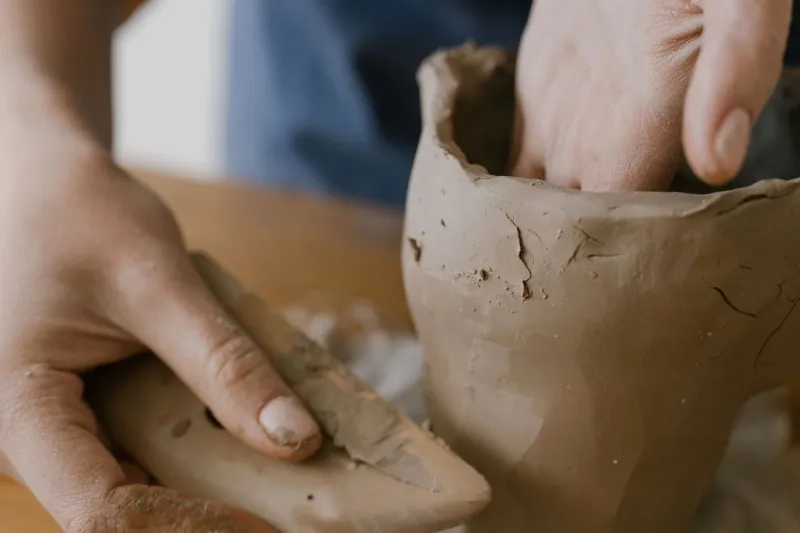
Evelyn discovered sculpture at fourteen, not in a classroom but in the creek bed behind her family's property. Bored one afternoon, she began shaping the dense red clay from the bank into rough figures — a horse, a hand, the outline of her sister's face. Her mother found them drying on the porch railing and stood there looking at them for a long time without saying anything.
That silence — the communicative kind, not the imposed kind — told Evelyn everything she needed to know.
She had no formal instruction. The nearest art school was in Asheville proper, and her family had neither the money nor the connections to pursue that kind of thing for a deaf girl from a farming background in the 1940s. What she had was clay, and time, and a quality of attention that most people never develop because they never have to.
Hearing artists, Evelyn would argue later, have the luxury of letting their other senses drift. Sound fills the gaps. It provides constant ambient information that the brain uses to orient itself in space without conscious effort. Remove that, and the remaining senses don't just compensate — they sharpen. They become deliberate. Every texture, every temperature shift, every subtle variation in surface and weight becomes a source of active data.
For Evelyn, sculpture wasn't a metaphor for this kind of perception. It was its most direct expression.
Finding a Larger World
In 1955, at twenty-one, Evelyn moved to New York City. It was a decision that struck her family as borderline reckless — a deaf woman with no formal training, no connections, and very little money, heading to a city famous for eating people alive. She moved into a shared apartment in Brooklyn with three other women, took a job pressing garments in a textile factory, and spent her evenings haunting the sculpture galleries of the Metropolitan Museum of Art.
She wasn't there to admire. She was there to study.
Evelyn had developed the habit of approaching sculptures with her hands before her eyes, running her fingers along surfaces when guards weren't watching, reading the work through touch the way a reader runs a finger under a line of difficult text. She understood things about those objects that most visitors never would — the hesitation in a particular chisel stroke, the tension held in a curve of marble, the way a bronze's surface temperature shifted between sun-touched and shadow-kept areas.
She began showing her own work in 1959, first in a small group exhibition in a Greenwich Village gallery that was more charitable than prestigious. The reception was cautious but curious. Critics noted an unusual quality in her pieces — a tactile density, an attention to surface that seemed to invite touch rather than observation. One reviewer wrote, somewhat condescendingly, that her work had "a raw, unschooled energy." He meant it as a qualification. Evelyn kept the clipping anyway.
The Work That Lasted
Over the following two decades, Evelyn Marsh built a body of work that defied easy categorization. Her figures were figurative but not realistic, abstract but never cold. They seemed to hold weight differently than other sculptures — not heavier, exactly, but more present, as if they occupied space with greater intention.
She also became an increasingly vocal advocate for accessibility in arts institutions, arguing — sometimes loudly, always persistently — that museums and galleries were designed exclusively for sighted, hearing visitors and that this represented both a moral failure and an artistic one. A sculpture you couldn't touch, she argued, was a sculpture only half-experienced.
By the late 1970s, several major American museums had begun developing touch-access programs for visually impaired visitors. Evelyn's advocacy was rarely cited in the official histories of those initiatives. She was used to that.
"Deaf women don't get footnotes," she once told a student. "We get the work."
What Silence Taught the Rest of Us
Evelyn Marsh died in 2001, at sixty-seven, in the same Asheville region where she'd grown up. She left behind over two hundred finished sculptures, a small archive of correspondence and personal essays, and a generation of artists and museum professionals who had been changed by her insistence that perception was not a single thing.
Her story is not a story about overcoming deafness. That framing would have irritated her, and it should irritate us too, because it implies that the goal was always to approximate hearing experience — to get as close as possible to what she'd lost. That's not what Evelyn Marsh did.
What she did was build an entirely different relationship with the physical world and then translate that relationship into objects that other people could feel. Her perceived limitation wasn't a detour around the destination. It was the destination itself.
Sometimes the world takes something from you, and what grows in its place turns out to be the most important thing you ever had.