She Was Never Supposed to Stay. Her Notebook Made Sure She Did.
The Woman in the Hallway
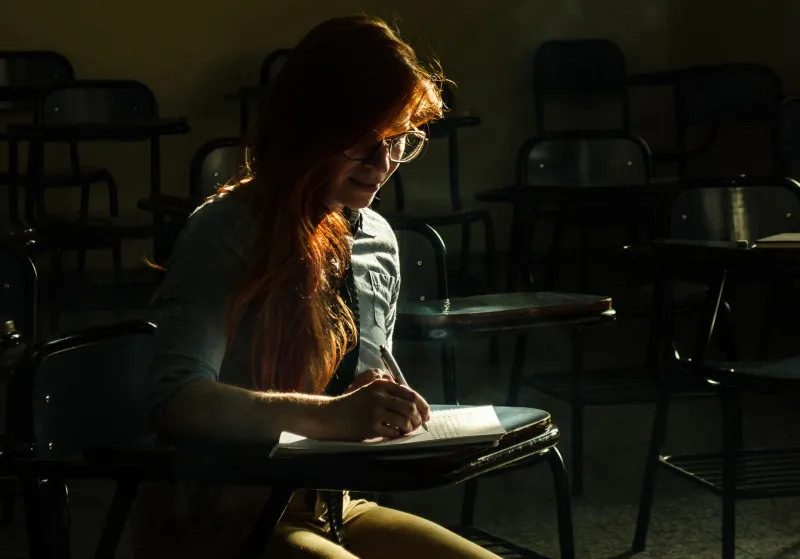
Substitute teachers occupy a strange liminal space in American schools. They're present but peripheral. Necessary but temporary. Trusted with classrooms but rarely trusted with anything else. They see everything — the crumbling ceiling tiles, the textbooks held together with rubber bands, the kids who haven't eaten — and then they go home, and nobody asks them what they noticed.
Denise Okafor noticed everything.
She'd fallen into substitute teaching the way a lot of people fall into work they didn't plan on — through necessity, through circumstance, through a series of doors that closed before she could walk through them. She'd started a degree in education at a community college in Akron, Ohio, but money ran out in her second year and life ran in. She had a kid to raise, a rent check to write, a series of part-time jobs that never quite added up to enough. A neighbor mentioned that the district was always looking for subs. She signed up. She stayed.
That was in 2003. She wouldn't stop substituting until 2014.
In between, she worked in forty-seven different schools across Ohio, West Virginia, and western Pennsylvania. She covered everything from kindergarten to AP History. She never held a permanent position. She was, by every institutional measure, a marginal figure.
She was also, it turned out, one of the most careful observers American public education had ever produced.
The Notebook Habit
The notebook started as a survival mechanism. Substitutes work without context — you show up, you figure out the room, you manage whatever's in front of you. Okafor began keeping notes to help herself remember the particulars of different schools: which rooms had working heat, which principals were helpful, which grade levels she'd be called back for.
But the notes evolved. She started documenting what she saw with a specificity that went beyond personal logistics. The date. The school. The district. The condition of the building. The materials available. What kids were eating, or not eating. How teachers talked about resources — or didn't, because they'd long since stopped expecting any.
She filled forty-three notebooks over eleven years. Spiral-bound, composition, legal pads — whatever she had on hand. She kept them in a storage bin under her bed in Akron.
She didn't have a plan for them. She just couldn't stop writing.
What Insiders Stop Seeing
One of the most consistent findings in organizational research is that people who work inside broken systems eventually stop perceiving the brokenness. It becomes ambient. Normal. The ceiling tile that's been water-stained for three years stops registering as a problem because it's always been there. The teacher who buys her own copy paper stops mentioning it because everyone buys their own copy paper.
Okafor never had the chance to normalize any of it, because she was never anywhere long enough. She arrived fresh to each school, each classroom, each particular variety of underfunding — and she wrote it down before familiarity could sand the edges off.
Her notebooks documented things like: a middle school in rural West Virginia where the only working projector was shared between fourteen classrooms and had to be reserved two weeks in advance. A high school in eastern Ohio where the chemistry lab hadn't been restocked with supplies in four years, so students were doing "experiments" with household items brought from home. An elementary school where the library had been closed and converted into a storage space, because there was no money for a librarian and no room in the budget to add one.
None of these things were secrets, exactly. Everyone in those buildings knew. But knowing and documenting are different things. Okafor was documenting.
When the Notebook Went Online
In 2014, Okafor's daughter — by then in college and studying journalism — convinced her mother to start posting excerpts from the notebooks on a blog. The writing was plain, almost reportorial. Dates, schools, observations. No editorializing, mostly. Just the record.
The blog found a small audience. Then, in early 2015, a post about a single week at a school in Wheeling, West Virginia went viral — shared first by education journalists, then by teachers' unions, then by political commentators across the spectrum. The post described, in Okafor's characteristically flat prose, five consecutive days during which students in a sixth-grade classroom had no working heat, no functioning bathroom on their floor, and no textbooks for two of their four core subjects.
The response was enormous. Not because the conditions were unique — they weren't — but because the documentation was so specific, so datestamped, so impossible to dismiss as exaggeration.
Okafor was invited to testify before an Ohio state legislative committee on education funding. She brought the notebooks. All forty-three of them. She stacked them on the table.
"I just wrote down what I saw," she told the committee. "I thought somebody should."
The Reckoning That Followed
The legislative outcomes were uneven, as legislative outcomes tend to be. Ohio passed a series of amendments to its school funding formula in 2016 that advocates credited, in part, to the public attention Okafor's documentation had generated. West Virginia's legislature convened a special study committee on facilities conditions. A coalition of Pennsylvania education nonprofits used Okafor's methodology — systematic, school-by-school documentation by rotating observers — to produce their own statewide infrastructure report.
None of it fixed everything. School funding in America is a labyrinthine problem, tied to property taxes and local politics and a hundred years of structural inequity. But the conversation shifted. And the shift had a paper trail — forty-three notebooks' worth.
Okafor eventually finished her education degree, in her late forties, through an online program. She now works as a consultant for education equity organizations, training community members to document school conditions in their own districts.
She still keeps a notebook. Old habits.
The View From the Margins
There's a particular kind of knowledge that only comes from being on the outside — from moving through institutions without ever fully belonging to them. Okafor never had the comfort of permanence, never got the chance to stop noticing. And that turned out to be exactly the vantage point American education needed.
She was never supposed to stay long enough to matter. Her notebook made sure she did.